

A significant portion of divorce cases filed in Turkey are filed by foreigners. Some of these are uncontested divorce cases, while others are contested divorce cases. However, there are important points that must be taken into consideration when it comes to foreigners filing for divorce in Turkey.
In this article, we have answered frequently asked questions regarding foreigners filing divorce cases in Turkey. It should be read carefully, and legal assistance from a lawyer should definitely be sought.
Can Foreigners File for Divorce in Turkey?
It is possible for foreigners to file for divorce in Turkey. Indeed, they do file such cases. However, certain differences arise between divorce cases filed by Turkish citizens and those filed by foreigners.
Foreigners do not need to be living in Turkey in order to file for divorce in Turkey. Nor is it necessary for them to have been married in Turkey. In fact, it is not even mandatory for them to be registered as married before the Turkish authorities.
Even if they were not married in Turkey, foreigners may file for divorce in Turkey. Persons who are registered as married in the official records of Türkiye may also file such a case. As for persons who are not registered as married in the official records of Türkiye, a document proving that they are married is required. This is referred to in the case as legal interest. However, if a person has somehow been recorded as “married” in their documents when entering Turkey, such persons do not need to submit a separate document proving that they are married.
Types of Divorce Cases Foreigners Can File in Turkey
Foreigners may file for divorce in Turkey in two ways. The first is called an uncontested divorce, and the other is called a contested divorce.
Uncontested Divorce in Turkey
If foreigners wish to file for divorce in Turkey, it is first necessary to determine whether the spouses have reached an agreement on this matter. If the spouses have agreed on;
- the divorce itself,
- custody of the children,
- alimony, meaning whether alimony will be paid and, if so, how much will be paid,
- pecuniary and non-pecuniary compensation, meaning whether compensation will be paid and, if so, how much will be paid,
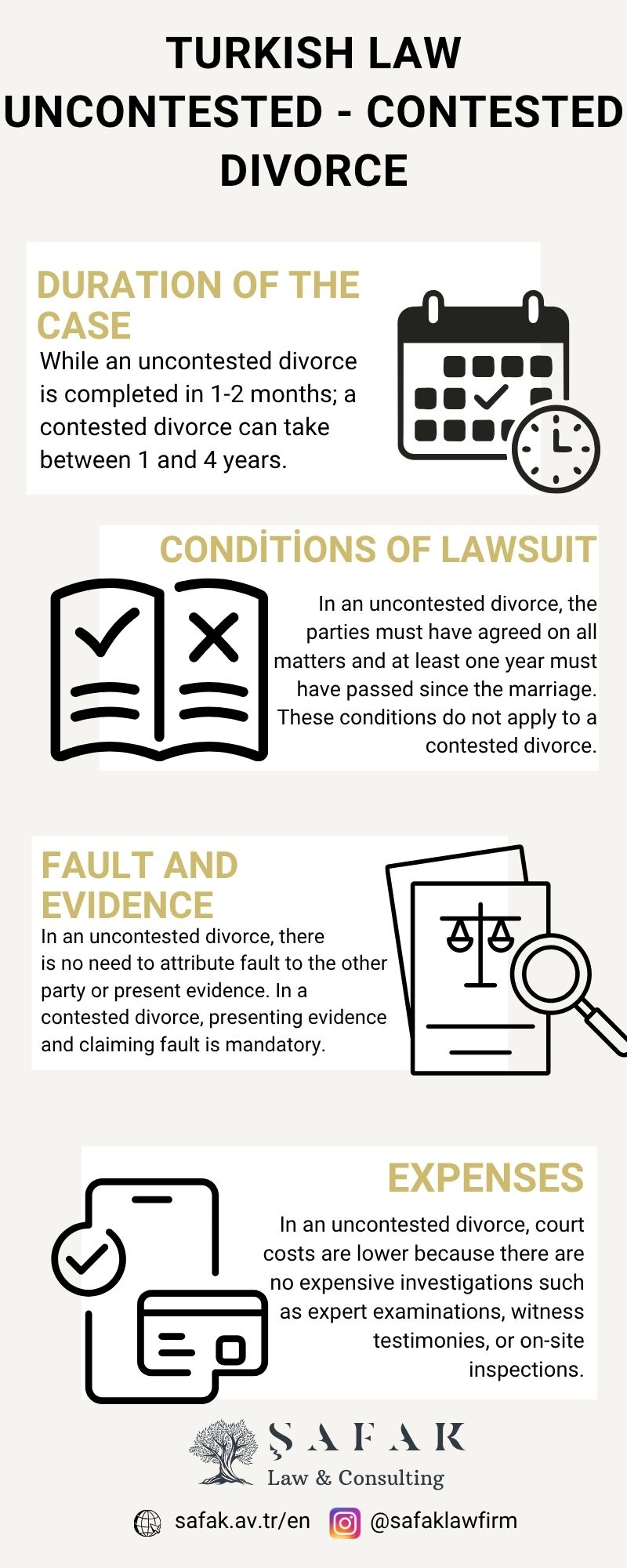
then there is no need to file a contested divorce case. By filing an uncontested divorce case, they may obtain a divorce quickly, within a short period such as 1–2 months. However, in order to file an uncontested divorce case in Turkey, the parties must have been married for at least one year. This rule also applies to foreigners.
If the divorce case to be filed by foreigners in Turkey will be an uncontested divorce, a protocol must be prepared regarding the matters agreed upon. In addition, an uncontested divorce petition must also be prepared. With these two documents, foreigners may file an uncontested divorce case. However, both documents must satisfy important procedural requirements set out in the law and in precedent decisions of the higher courts. Otherwise, filing a divorce case in Türkiye for foreigners may become difficult and even unmanageable. For this reason, legal assistance from a lawyer should definitely be sought.
Contested Divorce in Turkey
If one spouse wants to divorce but the other does not, or if both spouses want to divorce but cannot agree on issues such as alimony, compensation, and custody, a contested divorce case must be filed. This rule also applies to foreigners.
If the divorce case to be filed by foreigners in Turkey will be a contested case, the spouse filing the case must allege fault against the other spouse. In other words, there must be grounds that justify the divorce. Otherwise, the divorce case will be dismissed. Various grounds may be mentioned here. For example:
- Adultery, meaning infidelity
- Mental illness
- Abandoning the marital home
- Attempting to kill the spouse
- Physical violence
- Constantly coming home late
- Sexual inadequacy
- Pornography addiction
- The husband not working and failing to meet the needs of the household
- Indifference toward the spouse
- Insult and threat
- Mistreating the children
- Disclosing the family’s private information to others
- Leaving the woman without money for personal expenses
- Not paying attention to personal hygiene and care
Many similar grounds may also be listed. Such faults must be alleged against the spouse and must also be proven.
In contested divorce cases, the strongest and most commonly used type of evidence is known as witness testimony. Witnesses are very important in contested divorce cases. This also applies to foreigners. Neighbors, children living in the home, people from the neighborhood, colleagues, relatives, and others may all serve as witnesses.
How Does the Divorce Process Proceed for Foreigners in Turkey?
When foreigners file for divorce in Turkey, this means that they have entered into an important legal process. Therefore, it is very important to work with an experienced divorce lawyer. Before foreigners file for divorce in Turkey, the process must be planned. What will happen at each stage should be planned according to the possible scenarios.
If foreigners file a contested divorce case in Turkey, the process proceeds as follows:
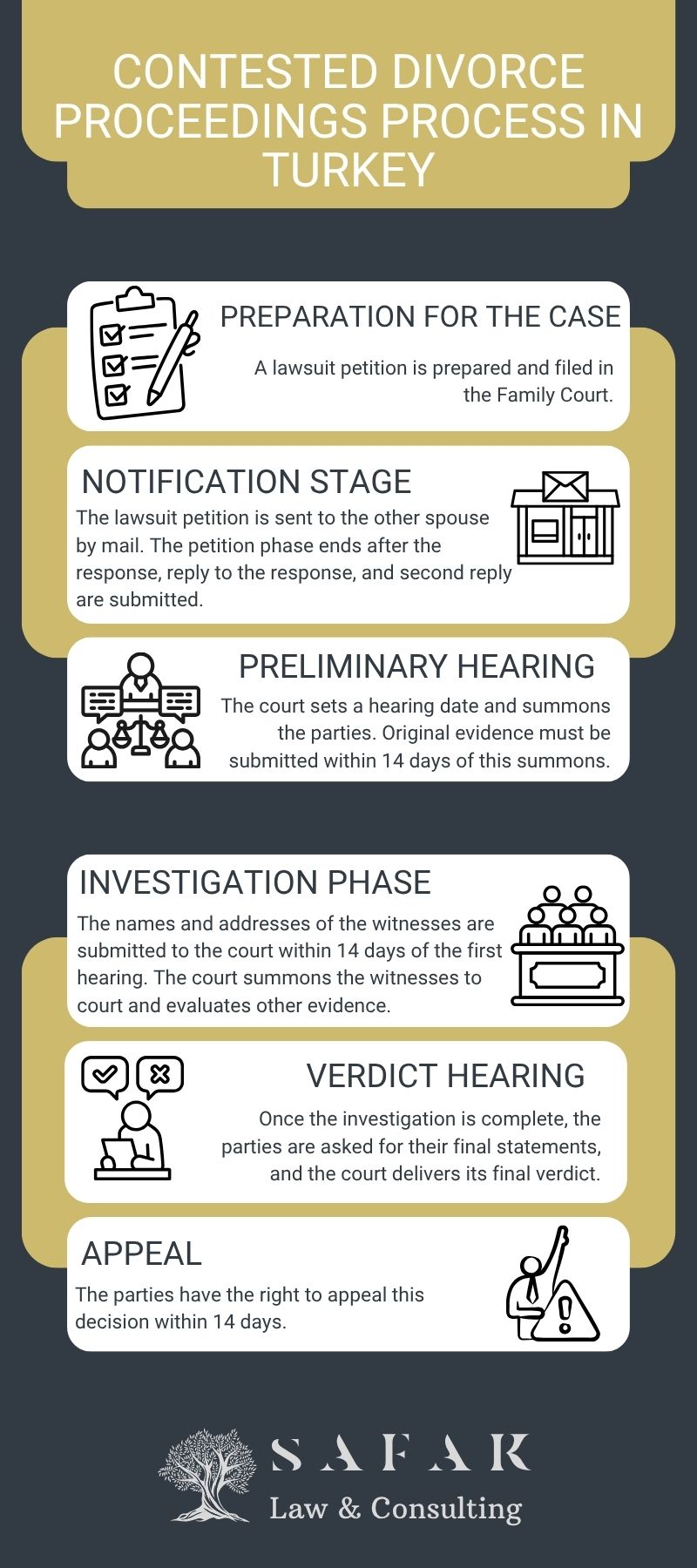
A divorce case in Turkey is filed with a petition. In this petition, faults sufficient to justify divorce must be alleged against the other party. It must be explained how these faults will be proven, and the evidence must be included. In divorce cases in Turkey, the most important evidence is witness testimony.
When foreigners file for divorce in Turkey, the judge first decides on urgent matters. For example, urgent issues such as alimony for the child and the woman, imposing precautionary measures on assets, who will remain in the home during the case, with whom the children will stay during the case, and when the other spouse will have contact with the children are decided.
After the urgent matters, the court sends the petition and its annexes to the other spouse via PTT. The other spouse has the right to submit a statement of response within 14 days. If a response is submitted, the claimant also has the right to submit a reply to the response. Then the defendant spouse also has the right to submit a second response. The defendant spouse may also file a divorce case. If they intend to do so, they must state this in the statement of response.
After the pleadings stage is completed in this way, the court sets a hearing date and summons the parties to the hearing. Within 14 days from this summons, the parties are expected to submit the originals of their evidence.
On the hearing date, the procedure we call the preliminary examination is followed. The evidence and points of dispute are determined. Generally, the merits of the case are not examined at this stage. After this first hearing, the judge asks the parties to notify the court, within two weeks, of who their witnesses are. In the following hearings, witnesses are heard and other evidence is evaluated. After this entire process is completed, the judge gives the decision at the final hearing.
If foreigners file an uncontested divorce case in Turkey, the process proceeds as follows:
First, an uncontested divorce protocol is prepared, and it is written down on which issues and in what manner the spouses have reached an agreement. Then the case is filed with a petition that does not require allegations of fault or evidence. The court then sets a hearing date. On the hearing date, both spouses must attend the hearing. In a contested divorce, they do not need to attend, but in an uncontested divorce, their attendance is required. At the hearing, the judge asks the parties about the provisions in the protocol and obtains their approval. Then the judge grants the divorce. The matter is resolved in a single hearing.
IMPORTANT: Civil proceedings in Turkey are subject to very strict procedural rules. There are important time limits. If these time limits are missed, loss of rights may occur. Especially foreigners should work with experienced divorce lawyers in order to avoid such losses.
Alimony in Divorce Cases in Turkey
If foreigners file for divorce in Turkey, the court may order alimony.
In an uncontested divorce in Turkey, the court orders the amount of alimony agreed upon by the spouses. Alternatively, the spouses may agree that no alimony will be paid. In that case, the court also decides that no alimony will be paid.
If the divorce case filed by foreigners in Turkey is a contested case, three types of alimony may arise. These are temporary alimony, poverty alimony, and child support.
Temporary alimony is the alimony that applies during the proceedings. It is ordered for the child and the woman from the beginning of the case until the case is concluded.
Poverty alimony is generally the alimony paid by the husband to the wife. The judge also determines the amount of this alimony. In deciding on this amount, the judge considers the fault status and financial means of the parties.
Child support, on the other hand, is the alimony paid by the other spouse for the child to the spouse who has been granted custody. In contested cases, the court decides how much this amount will be. The court determines an amount according to the financial needs of the child.
Custody of Children in Divorce Cases in Turkey
If the divorce case filed by foreigners in Turkey is an uncontested divorce, the spouses decide for themselves who will have custody of the children. However, if the divorce is contested, the judge decides with whom the children will stay.
When deciding with whom the children will stay, the court does not look at which party is right in the case. The judge grants custody to the person with whom it would be better for the child to stay.
In Turkey, it is also possible for the mother and father to have joint custody of the child. In fact, this is not expressly regulated in the law. However, Turkish courts may accept this only in uncontested divorce cases. There are precedent court decisions on this issue.
Division of Property in Divorce Cases in Turkey
Just as foreigners may get divorced in Turkey, they may also file a case for the division of property. A property division case may be filed together with the divorce case. In Turkey, property division is normally carried out after the divorce. However, in order to prevent one of the spouses from transferring or concealing assets, a property division case may be filed together with the divorce case, and precautionary measures may be imposed on the house, car, money in the bank account, or other assets. In this way, asset concealment or asset dissipation is prevented.
If the divorce of foreigners in Turkey will be uncontested, the spouses may agree among themselves on how to divide the assets. They may also agree that there will be no division. This is entirely a matter for the spouses to decide.
In Turkey, property division takes place, in simple terms, as follows: Assets purchased by the spouses after marriage are included in the property division process. The court determines the value of these assets. The assets remain registered under the spouse who owns them, but the spouse who owns the asset pays the other spouse an amount equal to half of the value of the assets.
Mahr Gold in Divorce Cases in Turkey
Contrary to popular belief, mahr gold is recognized by Turkish courts under Turkish law. A spouse who promised mahr to his wife at the time of marriage is obliged to pay this mahr gold at the time of divorce. However, the Turkish court requires the promise of mahr to be proven. In particular, a written mahr agreement is important in this regard. Even if there is no mahr agreement, there should at least be a video recording of the promise of mahr. Witness testimony is also an important type of evidence in this matter.
Jewelry Gold in Divorce Cases in Turkey
Divorce of foreigners in Turkey is largely similar to the divorce of Turkish citizens. In a divorce case in Turkey, jewelry gold may also be claimed by foreigners. Gold given at the wedding is generally deemed to belong to the woman. If the husband has taken this gold from the woman, he is obliged to return it. The woman must first prove the approximate amount and type of this gold. She may prove this through wedding photographs and witnesses. Then the woman must prove that the husband took this gold. She may also prove this through witnesses or written correspondence. In this case, the Turkish court orders that this gold be returned to the woman.
If the divorce of foreigners in Turkey will take place by mutual agreement, the spouses may also agree on the status of this gold. They may agree that it will not be paid, or, if it will be paid, how much will be paid.
Frequently Asked Questions by Foreigners Divorcing in Turkey
The divorce process for foreigners in Turkey is a highly common subject of inquiry. We have answered some frequently asked questions on this matter below.
How to Syrians Filing for Divorce in Turkey?
Due to the well-known civil war, Syrians in Turkey have the status of “temporary asylum seekers.” This status does not create a significant difference in divorce cases. Since there is currently no settled legal order in Syria, Syrian domestic law cannot be accessed, and most matters relating to divorce concern public order, Turkish law is applied. When Syrians divorce in Turkey, they may also make claims regarding custody, alimony, division of property, mahr, and jewelry gold.
How Do Individuals Who Have Acquired Turkish Citizenship File for Divorce in Turkey?
Divorce cases involving foreigners who have acquired Turkish citizenship are no different from those involving ordinary Turkish citizens. The divorce cases filed by these persons do not contain a foreign element due to the parties. In general, their cases proceed in a manner similar to the process explained above.
Can a Divorce Case Be Filed Against a Spouse Married Only by Religious Ceremony in Turkey?
In Turkey, a divorce case cannot be filed against a spouse married only by religious ceremony. The spouses are expected to have an official civil marriage. However, if foreigners were recorded as married in official documents upon entry into Turkey, the Turkish authorities do not request an opinion from the official authorities of the foreign country asking, “Are these persons officially married?” In other words, even if they are in fact married only by religious ceremony, they may file a divorce case.
What Can Be Done Against a Violent Spouse?
Foreign nationals may obtain a restraining order against a violent spouse pursuant to Law No. 6284. A lengthy lawsuit is not required for a restraining order. A restraining order is requested from the family court against the spouse on the allegation that they have “committed violence,” and the judge issues the restraining order the next day. This order is served by the police on the spouse who has committed violence or threatened violence. In this situation, the foreign spouse may not approach the spouse who is the victim of violence. If they do approach, a penalty of coercive imprisonment ranging from 3 days to 6 months is imposed.
How Long Does a Divorce Case Take in Turkey?
If the divorce case filed by foreigners in Turkey is an uncontested divorce, it is generally completed within 1 to 2 months. If the divorce case filed by foreigners in Turkey is a contested divorce, the case is generally completed within a period ranging from 1 year to 4 years. Many factors affect this period, such as whether the parties appeal the decision, whether the notification procedures are carried out without problems, whether there is a property division issue, whether the process is followed properly, the workload of the court, and similar matters.
Which Court Hears Divorce Cases Filed by Foreigners in Turkey?
If the divorce case filed by foreigners in Turkey will be a contested case, the case is filed before the family court located in the place of residence of either spouse or in the place where they last lived together for at least six months before the case. If the divorce case filed by foreigners in Turkey will be an uncontested case, the case may be filed before any family court in Turkey. In this regard, spouses are generally advised to choose a family court that is not very busy and that completes the process quickly.
Can a Divorce Decision Issued in a Foreign Country Be Valid in Turkey?
A divorce decision issued in a foreign country may be valid in Turkey. However, for this to be the case, the provisions contained in the decision must not be contrary to Turkish public order. For this purpose, a recognition and enforcement case must be filed in Turkey. At this point, however, in order to complete the process quickly, it is necessary to decide whether to file a recognition and enforcement case or a separate uncontested divorce case. This choice should be made by consulting a lawyer according to the specific circumstances of the case.
What Are the Court Costs and Lawyer’s Fees for a Divorce Case in Turkey?
The filing costs for a divorce case in Turkey in 2026 vary approximately between TRY 4,000 and TRY 10,000. This amount is affected by factors such as whether there will be claims regarding jewelry gold, mahr, or division of property, the number of witnesses, and similar matters. During the proceedings, the court may request an expert examination or an on-site inspection. In such cases, an expense generally ranging between TRY 3,000 and TRY 10,000 is paid for experts and inspection. However, these expenses are not requested when the case is filed; they are requested at later stages when the relevant procedural step comes.
Another expense that foreigners must pay when filing a divorce case in Turkey is the lawyer’s fee. In Turkey, in 2026, the minimum lawyer’s fee before family courts is TRY 45,000. However, this is the lower limit determined by law. The lawyer’s fee for a divorce case in Turkey is freely determined between the client and the lawyer. Many factors, such as the complexity and likely duration of the case, affect this amount.
What Should Be Done If the Address of One of the Foreign Spouses Is Unknown?
If one or both of the foreign spouses have a lawyer, notifications are sent to the lawyers by electronic notification, which is the easiest method. If one of the spouses does not have a lawyer, the notification is sent to their known address in Turkey. If there is no such address, it is checked whether they have a known address abroad, and notification is sent there. If none of these is available, then notification is made by public announcement. Ultimately, the notification procedure is completed in any event.
What Should Foreigners Pay Attention to When Filing a Divorce Case in Turkey?
In fact, in this article, we have explained the divorce process in Turkey only in a very general manner. Here, we have tried to answer the questions that foreigners commonly ask about divorce in Turkey. The process is much more complex than what has been explained here. Therefore, when foreigners file for divorce in Turkey, the most important point they should pay attention to is working with experienced divorce lawyers.