
It is quite common for foreigners to file complaints in Turkey. Just as Turkish citizens can file a criminal complaint with the public prosecutor’s office in Turkey, foreigners can also file complaints in the same way.
Below, we explain in detail the process regarding foreigners filing complaints in Turkey. We also answer frequently asked questions.
Can Foreigners File a Criminal Complaint in Turkey?
Foreigners can file complaints in Turkey. When a crime is committed against a foreign national in Turkey, the foreigner may need to file a complaint. This complaint may be submitted to the public prosecutor’s office or to police stations.
If a foreigner wishes to file a criminal complaint or make a complaint in Turkey, it is essential to seek assistance from a criminal lawyer in Turkey to ensure that the process is effective and free from errors. This is because the Turkish Criminal Code No. 5237 and the Criminal Procedure Code No. 5271 contain detailed rules regarding complaints by foreigners and different types of crimes.
In Turkey, there are two different legal procedures referred to as a “criminal complaint / report” and a “formal complaint.”
Criminal Complaint / Report:
For certain crimes in Turkey, it is not mandatory for the injured party to file a complaint in order for the public prosecutor’s office to conduct an investigation. This is because such crimes mostly concern society and public order. Therefore, a petition submitted in relation to such crimes is legally considered a “criminal complaint” or “report.” Crimes such as threats, homicide, bribery, blackmail, and similar offences fall into this category.
Formal Complaint:
For certain crimes in Turkey, the injured party must file a complaint in order for the public prosecutor’s office to conduct an investigation. These crimes directly concern the person who has suffered harm. Therefore, a petition submitted in relation to such crimes is legally considered a “formal complaint.” Crimes such as insult and disturbing a person’s peace and tranquility fall into this category.
In Which Situations Can Foreigners File a Criminal Complaint?
Foreigners may file a complaint in Turkey if they have been subjected to any crime regulated under the Turkish Criminal Code or other relevant laws. For example, a foreigner who has been insulted, threatened, blackmailed, assaulted, subjected to theft, whose car has been damaged, or who has been subjected to any other type of crime in Turkey may submit a complaint petition to the public prosecutor’s office.
Is There a Time Limit for Filing a Complaint in Turkey?
As explained above, there is a difference between a criminal complaint / report and a formal complaint. One of the differences between these two categories concerns the time limit for filing a complaint.
In general, there is no specific complaint period for crimes that are subject to reporting. Such crimes may be reported to the public prosecutor’s office at any time. However, criminal cases are subject to limitation periods, which vary depending on the type of offence. A complaint must be filed within this limitation period. For example, the limitation period for the offence of threat is 8 years.
In general, for crimes that are subject to a formal complaint, there is a 6-month limitation period, which is a forfeiture period under Article 73 of the Turkish Criminal Code. This period also applies to foreigners. For offences committed abroad, this period starts from the date on which the foreigner enters Turkey, pursuant to Article 11/2 of the Turkish Criminal Code.
Which Evidence Is Important When Foreigners File a Complaint?
When foreigners file a complaint in Turkey, they should present evidence showing that the crime was actually committed. However, this duty does not belong only to the foreigner. Public prosecutors are also responsible for investigating the offence ex officio. Of course, the best approach is for the foreign person to prepare the evidence related to the crime in a complete, clear, and organized manner that will also facilitate the work of the prosecutor’s office.
The following types of evidence are particularly important when foreigners file a complaint:
- Message Screenshots: Screenshots from social media platforms and messaging applications such as WhatsApp are important evidence. However, a criminal conviction may not be based solely on randomly taken screenshots. The screenshot should preferably be taken as a screen video recording, and the sender’s phone number should be shown by entering the sender’s profile. Whether screenshots can be used as evidence has been discussed many times in judicial decisions, and important criteria have emerged. Legal assistance should definitely be obtained when preparing this type of evidence.
- Video Recordings: Video recordings are also among the important types of evidence. However, if these recordings belong to police surveillance cameras or workplace security cameras, it should be noted that such recordings are deleted at regular intervals. Therefore, it is necessary to act quickly in order to obtain the recordings. If the person has personally recorded the commission of the crime, such recordings may sometimes be considered lawful evidence and sometimes unlawful evidence. This assessment should definitely be made with the assistance of a lawyer.
- Witnesses: Witness testimony is among the most important types of evidence in Turkey. Witness statements must be based on direct observation. A witness who only states what they heard, rather than what they personally saw, may not be significant. It is very important for witnesses to give their statements at the right time and through the correct procedure.
- Hospital Records: Hospital records may also constitute important evidence depending on the type of crime. However, it is of great importance to determine which records should be obtained for the offence under investigation and how the relevant parts of those records should be presented.
Apart from these, many other materials may also serve as evidence, such as bank receipts, assault reports, contracts, email records, HTS records — that is, location and communication traffic records — flight information, and similar documents.
IMPORTANT: The most important point here is to prepare the evidence properly in order to facilitate the work of the prosecutor’s office and ensure that the process proceeds correctly. For this reason, foreigners should definitely seek assistance from an experienced lawyer.
The Process and Stages After Filing a Complaint Petition in Turkey
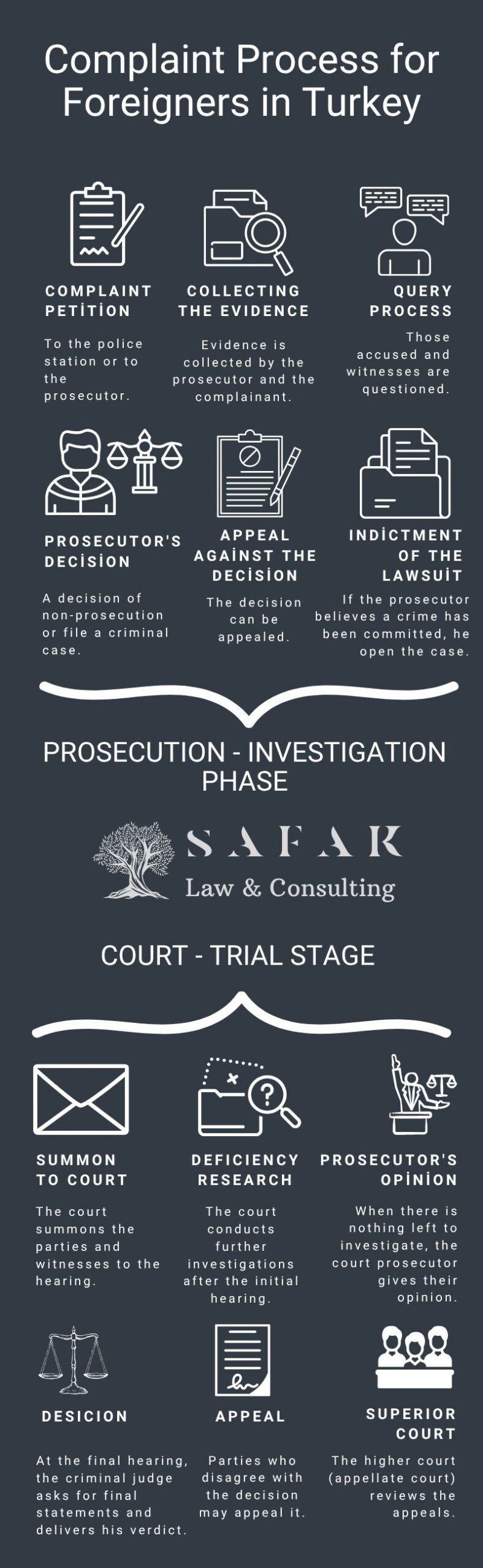
After foreigners file a complaint in Turkey, there is a two-stage process. The first is the public prosecutor’s office stage, and the second is the court stage.
The Public Prosecutor’s Office Investigation Stage in Turkey
After a criminal report or complaint petition is submitted, the public prosecutor’s office examines the evidence presented. It summons the person or persons complained against to give a statement. If they do not appear, they may be brought by force. The prosecutor’s office takes their statements and evaluates the evidence. If necessary, the prosecutor also searches for evidence ex officio. At the end of this process, the prosecutor decides whether or not to file a criminal case.
During the investigation stage, foreigners may follow the investigation file. They may obtain information about the prosecutor’s office procedures. Where necessary, they may submit additional petitions and present evidence. If there is any evidence that foreigners want to be obtained, or any person whose statement they want to be taken, they may request this from the prosecutor.
When the process is completed, if sufficient evidence has been found, a criminal case is filed by the public prosecutor. If sufficient evidence has not been found, a “decision of non-prosecution” is issued. This decision means that “there is no situation requiring me to file a case.” Sometimes the evidence is insufficient, and sometimes it becomes clear that the crime was not committed. In such cases, a “decision of non-prosecution” is issued.
Although very rare, prosecutors may sometimes issue a “decision that there is no ground for investigation.” This means that, from the very beginning, there is no need to conduct an investigation. This situation usually arises in complaints concerning events that are impossible to have occurred.
Ultimately, however, if the evidence is properly submitted and the investigation stage is followed correctly, the prosecutor prepares an “indictment” and files a criminal case. In order to reach this stage, the process should be followed by experienced lawyers.
The Criminal Court Trial Stage in Turkey
The second stage after foreigners file a complaint in Turkey is the criminal case. The main duty of the prosecutor, after collecting the evidence, is to file a case if the prosecutor concludes that a crime has occurred. The actual trial is conducted by the criminal court. Depending on the seriousness of the offence, the trial is conducted either by the “Criminal Court of First Instance” or the “High Criminal Court.”
Persons who were referred to as “suspects” during the investigation stage are now referred to as “defendants” during the trial stage. The court hears the defendants and the complainant. It evaluates the evidence and conducts the trial. Ultimately, the court may issue various decisions. Some of these are as follows:
- Acquittal: If there is not sufficient evidence that the defendants committed the crime, or if it has been proven that they did not commit the crime, the court issues an acquittal decision.
- Dismissal of the Case: If the complainant withdraws the complaint, the court decides to dismiss the case.
- Deferral of the Announcement of the Verdict: If the sentence imposed on the defendant is 2 years or less, the court may decide to defer the announcement of the verdict. In this case, the defendant does not go to prison. However, a 5-year supervision period begins for the defendant. If the defendant commits another intentional crime during this period, the penalties for both crimes are enforced together. If the defendant does not commit an intentional crime during this period, the result is as if the offence had never been committed.
- Suspension of the Sentence: In some cases, instead of deferring the announcement of the verdict, the court may decide to suspend the sentence. This is not actually a “postponement of the execution of the sentence.” This decision is also similar to the decision to defer the announcement of the verdict. However, in this case, a 3-year supervision period applies, and if no intentional crime is committed during this period, the result is as if the sentence had been “executed.”
- Judicial Fine: In Turkey, for some crimes, a judicial fine is imposed directly, while for some crimes, imprisonment is converted into a judicial fine. In some cases, a judicial fine is also imposed in addition to imprisonment.
- Imprisonment: A complaint filed by foreigners in Turkey may, in some cases, result in the defendant being sentenced to imprisonment.
IMPORTANT: The decision to be issued by the court is directly related to how closely the complainant follows the process. Therefore, when foreigners file a complaint in Turkey, it is important for them to work with experienced lawyers.
What Rights Do Foreigners Have When They File a Complaint in Turkey?
Foreigners who file a criminal complaint with the public prosecutor’s office in Turkey have certain fundamental rights under the Criminal Procedure Code. Some of these rights are as follows:
- Right to an Interpreter: If the foreign person does not know Turkish sufficiently to express themselves, an interpreter is appointed for them by the public prosecutor or the judge during the investigation stage, pursuant to Article 202 of the Criminal Procedure Code. The essential points of the complaint are recorded in the official minutes through this interpreter.
- Right to Request the Collection of Evidence: Foreigners who file a complaint in Turkey may request both the public prosecutor and the criminal court to collect missing evidence. They may also provide guidance on how such evidence can be obtained.
- Right to Obtain Information / Examine Documents: Both during the investigation stage and during the prosecution stage, namely the court proceedings, foreign persons and their lawyers have the right to examine the case file and obtain information. Unless there is a confidentiality order, they may review the documents in the file and obtain a copy of them.
- Right to Attend Hearings: When foreigners file a complaint in Turkey, they may attend and follow the hearings, either together with their lawyers or without a lawyer.
- Right to Have Witnesses Heard: One of the most important rights during both the public prosecutor’s investigation stage and the trial stage is the right to have witnesses heard. Foreigners may also bring witnesses in Turkey and have them heard.
- Right to Ask Questions: When foreigners file a complaint in Turkey, they may ask questions both to the defendant and to the witnesses. The questioning and the answers take place during the hearing and are included in the court record.
- Right to Benefit from a Lawyer: This is the most important and necessary right. Foreigners have the right to have a lawyer present with them in every procedure during the investigation and trial stages in Turkey.
- Right to Object to Decisions: Another important right is the right to object to decisions issued by the public prosecutor or the court. The reasons why the decision of the public prosecutor or the court is unlawful or unjust must be carefully explained.
How Much Are the Costs of Filing a Complaint in Turkey?
There is no fee for filing a complaint or for a criminal case in Turkey. Since crimes also concern public order, all costs are covered by the public prosecutor’s office. At the end of the process, if the defendant is found to be at fault, these costs are collected from the defendant. If the defendant is acquitted, the costs are covered by the public prosecutor’s office. The complainant does not pay any costs.
The only cost item that foreigners may need to pay when filing a complaint in Turkey is the lawyer’s fee. According to the tariff determined by the bar association, the minimum lawyer’s fee is TRY 45,000 for offences falling within the jurisdiction of the Criminal Court of First Instance. For offences falling within the jurisdiction of the High Criminal Court, the minimum lawyer’s fee is TRY 65,000. These amounts are the minimum mandatory amounts set by the bar association. Depending on the specific circumstances of the case, the lawyer’s fee may be these amounts or higher. In order to obtain precise information, it is necessary to consult a lawyer.
Frequently Asked Questions About Foreigners Filing a Complaint in Turkey
It may be useful to answer some frequently asked questions regarding foreigners filing a criminal complaint in Turkey.
How Can a Foreign National Grant a Power of Attorney to a Turkish Lawyer?
A foreigner who is legally present in Turkey and speaks Turkish may go to any notary public and grant a power of attorney to a lawyer. A foreigner who does not speak Turkish may grant a power of attorney to a lawyer through sworn translators, who are usually located in the same building as notary offices, or through sworn translators they bring themselves. In criminal cases and public prosecutor’s investigations, a general power of attorney for legal representation is sufficient.
What Should a Foreigner Who Suffers Violence from Their Spouse Do?
A foreign person who suffers violence from their spouse may obtain a restraining order under Law No. 6284, either before or after filing a complaint with the public prosecutor’s office. For this order, the existence of a threat of violence is sufficient. No evidence is required.
Can a Foreigner File a Criminal Case in Turkey?
In Turkey, investigation files are opened by public prosecutors. Likewise, at the end of the investigation, criminal cases are also filed by public prosecutors. Individuals may only submit a complaint petition. Therefore, foreigners cannot directly file a criminal case; they can only submit a complaint petition.
What Decisions Can the Public Prosecutor’s Office Make When Foreigners File a Complaint?
The public prosecutor’s office first assigns the police to take the statement of the person complained against. If there is evidence that must be collected urgently, it collects such evidence. If deemed necessary, the prosecutor may hear the complainant again. If any protective or procedural measures need to be taken, the prosecutor takes them. If the act of the person complained against requires arrest, the prosecutor may request an arrest warrant from the judge. These are the types of decisions and actions that may be taken once a complaint is filed. At the end of the process, the prosecutor may either issue a “decision of non-prosecution,” commonly referred to as “takipsizlik” in Turkish, or prepare an indictment and file a criminal case.
Can Foreigners File a Compensation Case Against the Person They Complained About?
If a foreigner files a complaint in Turkey and has suffered material or non-material damage, they may also file a separate compensation lawsuit for pecuniary and non-pecuniary damages. It is not necessary to wait for the public prosecutor’s investigation or the criminal court proceedings to be completed in order to file this lawsuit.
Are Foreigners Deported If They File a Complaint?
Foreign nationals are not deported merely because they have filed a complaint. For deportation, there must be specific grounds requiring their deportation. For example, if they are not legally present in Turkey, they may be deported. However, unless there are such special circumstances, they are not deported. The best approach is to submit the complaint through a lawyer.
Can Foreigners Later Withdraw Their Complaint?
After foreigners file a complaint in Turkey, it is possible for them to withdraw the complaint. However, caution is required when doing so. If it is claimed that the incident described in the complaint petition did not actually occur, the offence of false accusation may come into question for the complainant. However, if the person merely withdraws the complaint, this does not constitute the offence of false accusation. Complaints may be withdrawn in offences that are subject to a formal complaint. In offences that are subject to reporting, there is no withdrawal of complaint.
If a Foreigner’s Complaint Is Unjustified, Can They Be Punished for False Accusation?
When foreigners file a complaint in Turkey, sometimes the allegation may not be proven. However, this does not mean that the foreign complainant has made a false accusation. It only means that they could not prove the offence they alleged. Therefore, no punishment for false accusation is imposed on this basis alone. In order for a punishment for false accusation to be imposed, it must be shown that the complainant knew that the incident did not happen in the way alleged, but nevertheless made a false statement. Proving this is very difficult.
Is the Person Complained Against Immediately Arrested When Foreigners File a Complaint?
Under the Criminal Procedure Code, arrest is a precautionary measure. Arrest is a measure taken to prevent the criminal proceedings from becoming ineffective, depending on circumstances such as the risk that the person complained against may flee, tamper with evidence, or similar situations. In such a case, the person complained against may be arrested. For this to happen, the judge must form an opinion that the crime has been committed. In addition, the law provides that for certain crimes, grounds for arrest are presumed to exist. Crimes such as robbery, homicide, drug trafficking, and similar offences fall into this category.
Points to Consider During the Complaint Process for Foreigners
Above, we explained what kind of process foreigners may face when they file a complaint in Turkey. Although the process may seem complicated, it can be completed more easily with the assistance of a lawyer in Turkey.
Foreigners must collect their evidence properly and follow the process closely during this period. For this reason, obtaining legal assistance is of great importance.